
Why Jowls Form — and What Can Actually Be Done About Them
Author: Ross Farhadieh | Plastic & Reconstructive Surgeon | http://panthea.com.au
Part of the series: Understanding Facial Ageing — A Guide for Patients
—
Key Takeaways
- Jowls are not caused by skin stretching. They are caused by the anatomical expansion of the premasseter space — a gliding plane over the masseter muscle — whose roof descends with age.
- The mandibular ligament is the key fixed point that defines exactly where jowls form.
- The labiomandibular fold (marionette line) and jowl form together through related but distinct mechanisms, both originating in the premasseter space.
- Effective treatment must address the structural cause — not simply pull the skin surface tighter.
- Surgery targeting the SMAS and premasseter space provides the most anatomically correct and lasting correction.
What Is a Jowl?
Jowling — the soft, rounded fullness that develops along the jaw below the corner of the mouth — is one of the most common concerns that brings patients to a plastic surgeon. It signals a change in the fundamental shape of the face: the clean jaw of youth replaced by a heavy, drooping lower face.
But here is what most people are not told: **jowls are not caused by the skin sagging.** They are caused by a specific structural change in the deeper layers of the face — and that distinction is the key to understanding which treatments will actually work.
The Premasseter Space: The Anatomical Birthplace of Jowls
To understand jowls, you need to understand one key structure in layer 4 of the face: the **lower premasseter space**.
“This space overlies the lower half of the masseter and is analogous to the temporal space in that it overlies the deep fascia of a muscle of mastication. This gliding soft tissue plane allows opening of the jaw without restriction and avoids excessive distortion of the overlying soft tissues.”
The masseter is the large chewing muscle on the side of the jaw. Overlying its lower half is the premasseter space — a gliding plane that exists specifically so that jaw movement does not drag and distort the overlying skin. The roof of this space is formed by the **platysma** muscle — the broad, flat muscle of the lower face and neck.
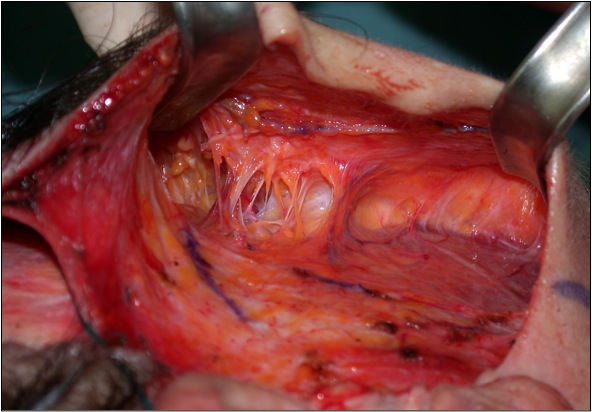
What this diagram shows: A dissected lateral view of the lower face revealing the rhomboidal premasseter space in full anatomical context. The platysma roof is shown on the outer surface; beneath it, the space opens down to the masseteric fascia floor. The four boundaries of the space are clearly labelled — the PAF posteriorly, the masseteric ligaments anteriorly, and the unsupported inferior mesenteric-like boundary inferiorly. The mandibular branch of the facial nerve is traced running under the inferior boundary and rising to the mandibular ligament. The buccal fat pad is shown prolapsing inferiorly in the aged configuration.
How the Jowl Forms
In youth, “the spaces are more potential than real and do not open readily with blunt dissection.” The premasseter space is a tight, virtual plane — its walls in near-contact, its boundaries firm.
With age, this changes. “The multilinked fibrous system attenuates with aging, with decreasing strength of the ligaments and increasing laxity.” The boundaries of the premasseter space weaken — particularly the masseteric ligaments at its anterior border and the mesenteric-like inferior boundary, which contains no ligament at all. As these boundaries loosen, the space expands, and its platysma roof descends.
The resulting tissue descent piles up against the one structure that does not yield: the mandibular ligament — a strong, discrete osteocutaneous ligament anchoring directly from the jawbone to the dermis. Tissue accumulates just behind and above this anchor point, creating the characteristic rounded jowl bulge.
“The jowl develops as a result of distension of the roof of the lower premasseter space with resultant descent of the tissues below the body of the mandible. The more prominent the jowl, the more apparent will be the cutaneous tethering provided by the mandibular ligament.”
The dimple commonly visible between the marionette line and the jowl? That is the mandibular ligament itself — holding firm while the tissue on either side has descended.
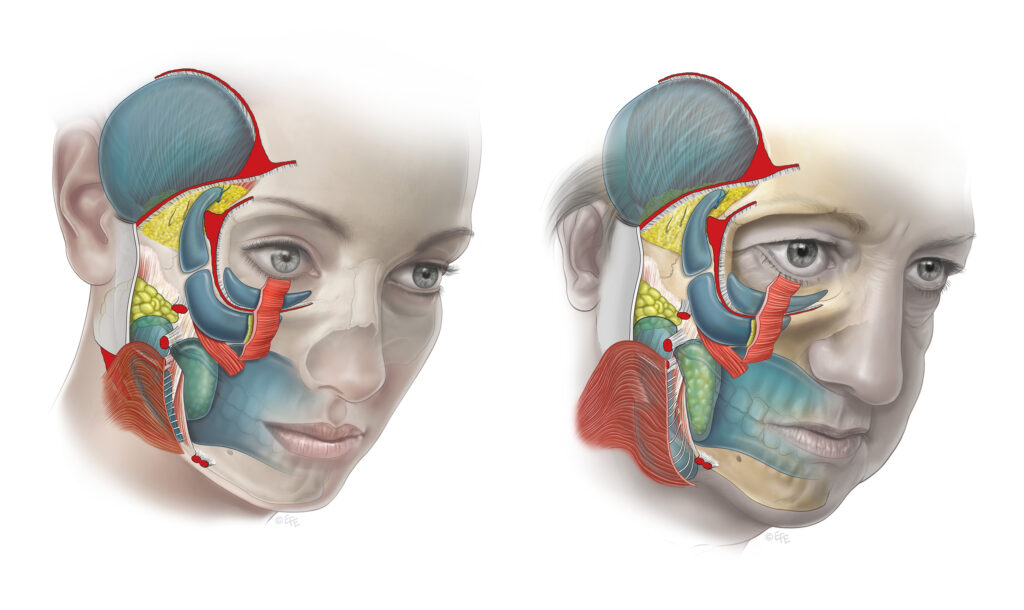
What this diagram shows: A side-by-side cross-section of the lower face in youth and age. In the young face (left), the premasseter space is closed, the platysma roof is taut and horizontal, and the mandibular ligament anchors the skin at the jaw border. In the aged face (right), the space has expanded, the platysma has descended into the jowl position, and the buccal fat pad is shown displacing inferiorly into the labiomandibular fold region. The mandibular ligament remains as the only fixed point, creating the surface dimple between the marionette fold and jowl.
The Labiomandibular Fold: The Other Half of the Story
The labiomandibular fold — the groove running from the corner of the mouth toward the chin, sometimes called the marionette line — forms through a closely related but distinct mechanism.
Anterior to the premasseter space is the **buccal space**, containing the buccal fat pad. The buccal space is positioned behind the masseteric ligaments that form the anterior border of the lower premasseter space. As these masseteric ligaments weaken with age, they no longer confine the buccal space effectively. “Distension of the weaker masseteric ligaments at the anterior border of the lower premasseter space (below the key masseteric ligament) allows inferior displacement of the buccal fat (within the buccal space), the anatomical basis for the development of the labiomandibular fold.”
The mandibular ligament then provides the transition point. Above and medial to it: the labiomandibular fold, formed by descending buccal fat. Below it: the jowl, formed by the descending platysma roof of the premasseter space. “Accordingly, the anatomical solution to correcting these aging changes is to reduce the inferiorly displaced buccal fat and to tighten the roof of the premasseter space.”
What Makes Jowls Worse?
Several factors accelerate or amplify jowl formation:
Bone loss. The prejowl area of the mandible is among the areas most susceptible to age-related skeletal resorption. “The resultant deficiencies in the skeletal foundation have a significant effect on the overlying soft tissues.” As the bone recedes, the mandibular ligament’s insertion point is effectively moved backward, and the jawline loses its bony prominence — making the overlying soft tissue appear to droop further.
Weight change. Significant weight fluctuation affects the volume of the buccal fat pad and the facial fat compartments, which can alter the prominence of both the labiomandibular fold and the jowl.
Genetics. The strength of the retaining ligaments and the thickness of the SMAS are partly hereditary. Individuals with inherently weaker ligamentous systems develop jowls earlier.
Volume of mandibular movement. “The spaces expand with aging in proportion to the amount of movement. This is greatest with the lower premasseter space and the related mandibular movement.” A lifetime of chewing and talking progressively distends the premasseter space.
Treatment Options
Non-Surgical
Dermal fillers in the prejowl. Volume placed along the mandible either side of the jowl can smooth the jawline by reducing the depth of the prejowl hollow relative to the jowl. This does not correct the jowl itself — it adjusts the contrast around it. Temporary (12–18 months).
Energy-based skin tightening. Radiofrequency and focused ultrasound devices stimulate collagen remodelling and can provide modest tightening of the skin and superficial SMAS. Best suited to early, mild jowling with good skin quality.
Thread lifts. Dissolvable threads suspended from the temple gather the lower face tissue temporarily. Variable results; modest at best and temporary correction.
Surgical
Surgery remains the only approach that addresses the anatomical cause of jowling directly.
SMAS-based facelift. The key surgical step for jowl correction is entering and tightening the premasseter space. The mobile SMAS anterior to the parotid capsule is released from the masseteric ligaments and advanced, tightening the roof of the premasseter space and correcting both the jowl and labiomandibular fold at their anatomical source.
The critical principle: “To satisfactorily tighten the medial cheek and jowl it is necessary to extend the SMAS release into the mobile SMAS forward of the parotid capsule and release the SMAS from the restraining effect of the vertical line of masseteric cutaneous ligaments.” Simple SMAS plication without this ligament release only addresses the lateral cheek — not the jowl proper.
**Limited dissection composite facelift.** The technique employed at Panthea. By keeping the skin and SMAS as a composite unit rather than dissecting them as separate layers, the surgeon obtains a stronger, better-vascularised flap that can be tightened with less skin tension. The subcutaneous undermining is limited to the area of excess skin to be removed; all further access is sub-SMAS through the premasseter space. “There are several advantages in limiting the subcutaneous undermining. In addition to having less bleeding during sub-SMAS dissection and a dramatically lower hematoma rate, limiting the skin undermining to only the area of excess skin that will be removed completely avoids residual subcutaneous dead space. The result is minimal postoperative ecchymosis, without the need for drains.”
**Neck lift and platysmaplasty.** Where the neck is involved, the platysma can be tightened directly in the midline under the chin, further supporting the floor of the lower face and improving the cervicomental angle.
Why Pulling the Skin Alone Doesn’t Work
This point is worth emphasising, because it underpins the history of facelift surgery. Skin has viscoelastic properties — it stretches. “Facial shape cannot be maintained by tightening the skin envelope alone. Additional manipulation of the underlying parenchyma is required.” A facelift that relies on skin tension will look pulled immediately postoperatively, then relax as the skin stretches — often within months to a couple of years.
Jowl correction that is lasting requires correction of the structural cause: tightening the SMAS at the premasseter space, releasing and replacing the masseteric ligaments, and reducing the buccal fat where it has descended. The skin is then redraped with minimal tension — producing a natural result rather than an operated one.
Frequently Asked Questions About Jowls
At what age do jowls typically appear?
Most people notice jowling beginning in their late forties to early fifties, though genetics, bone structure, and lifestyle strongly influence timing. Individuals with congenitally weak skeletal structure may develop early jowling in their forties.
**Will losing weight help with jowls?**
Not reliably. Weight loss may reduce the volume of the jowl slightly, but it can also deplete adjacent facial fat compartments — making the face look more gaunt without correcting the drooping. In some patients, weight loss makes jowls look more prominent by reducing cheek volume while the jowl persists.
Is there a permanent non-surgical treatment for jowls?
No current non-surgical treatment provides permanent structural correction of true jowling. Non-surgical options can camouflage or temporarily slow jowl progression but cannot correct the expanded premasseter space and descended platysma roof.
Can fillers fix jowls?
Fillers cannot correct the structural descent of tissue that causes jowls. They can improve the visible contour by adding volume to the adjacent prejowl mandible, reducing the contrast between the jowl and the jawline. This is appropriate for mild early jowling and temporary in effect.
What is the difference between a marionette line and a jowl?
Marionette lines (labiomandibular folds) are the grooves running from the corners of the mouth toward the chin — caused by descent of the buccal fat. Jowls are the rounded bulges below and behind the mandibular ligament — caused by the descending platysma roof of the premasseter space. They share a common anatomical driver (premasseter space expansion) and commonly occur together, but they are distinct structures.
How long does surgical correction of jowls last?
A well-performed SMAS-based facelift addressing the premasseter space provides durable correction lasting many years. The ageing process continues, but the structural repair is long-lasting.
What are the risks of facelift surgery for jowls?
The main risks are haematoma (blood collection beneath the flap), nerve injury (typically temporary), skin healing problems, and scarring. Permanent facial nerve injury is rare, reported at 0–0.3% in large series. The limited dissection composite technique substantially reduces haematoma risk by minimising dead space.
Am I a good candidate for facelift surgery?
Ideal candidates have significant jowling, adequate skin elasticity, and good general health. Age is not the determining factor — anatomy and health are. Both younger patients (late forties) and older patients (seventies and beyond) can achieve excellent results when the anatomy warrants surgery.
Summary
Jowls are an anatomical problem, not a skin problem. They originate in the premasseter space — a gliding plane over the masseter that expands with age as its boundaries weaken, allowing the platysma roof to descend and accumulate behind the unyielding mandibular ligament. The labiomandibular fold forms alongside the jowl as the buccal fat descends through the weakened masseteric ligaments.
Effective correction addresses this structural cause. For mild early jowling, non-surgical options provide temporary improvement. For significant jowling, surgery targeting the SMAS and premasseter space provides the most anatomically correct, natural, and durable result.
—
**Related Articles:**
– [Why Your Face Ages the Way It Does — A Complete Anatomy Guide](/blog-01-pillar-facial-ageing-anatomy)
– [The Tear Trough: What It Is and What Can Be Done About It](/blog-03-cluster-tear-trough)
– [Understanding Facelift Techniques: From Skin-Only to Deep Plane](/blog-04-cluster-facelift-techniques)
– [Volume Loss, Bone Resorption and the Ageing Face](/blog-05-cluster-volume-loss)
—
*Ross Farhadieh is an internationally recognised plastic and reconstructive surgeon, educator and editor of two major plastic surgery reference textbooks. He practises at [panthea.com.au](https://www.panthea.com.au). Text excerpts and diagram descriptions © Ross Farhadieh and respective co-authors. All rights reserved.*